
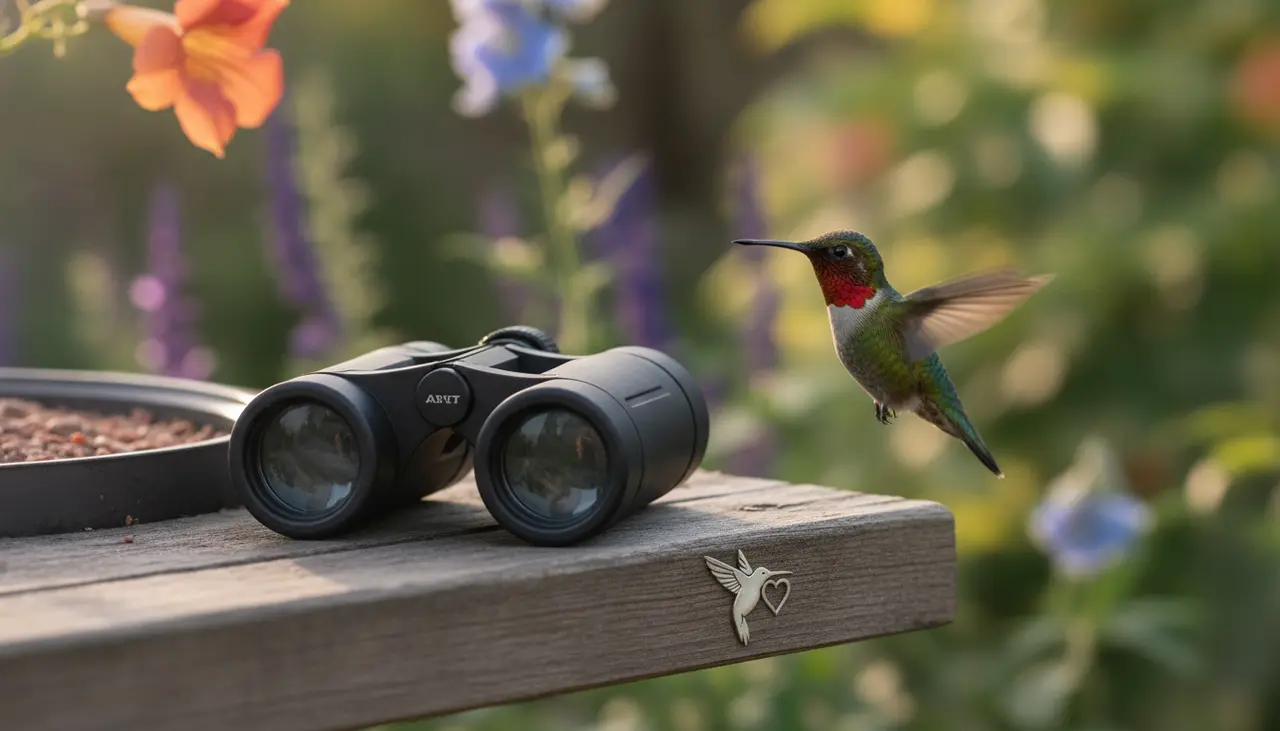
Best Binoculars for Close-Range Birding: See Every Jewel-Toned Detail
Disclosure: This post contains affiliate links. If you click through and make a purchase, I may earn a commission at no additional cost to you. I only recommend gear that meets the safety and quality standards for our backyard feathered friends.
If you have ever tried to watch a Ruby-throated or Anna’s hummingbird from your kitchen window, you know the frustration. You see a flash of green and red, but the moment you try to focus your eyes, they’ve zipped away. Standard binoculars often make this worse because they are designed to look at hawks in the sky or deer across a field—not a tiny bird six feet away on your feeder.
The best binoculars for close-range birding are those with a "Close Focus" distance of 6 feet or less and a magnification of 8x. For the absolute best experience watching hummingbirds, the Pentax Papilio II is the gold standard for close-up detail, while the Vortex Diamondback HD 8x42 offers the best all-around durability for busy households.
Why You Need Specialized Optics for the Backyard
Most people assume that "bigger is better" when it comes to binoculars. However, if you grab a pair of high-powered 10x or 12x binoculars, you’ll likely find that you can’t actually focus on the bird sitting on your porch railing. This is because every lens has a minimum distance it requires to create a sharp image.
For those of us managing a household, our "birding" often happens in 5-minute windows between school runs or while the kids are playing in the yard. We need optics that are easy to grab, quick to focus, and capable of showing us the "up-close magic" of a bird’s iridescent gorget (throat feathers) without having to stand 20 feet back.
Top Recommendations for Close-Range Birding
| Model | Magnification | Close Focus Distance | Weight | Best For |
|---|---|---|---|---|
| Pentax Papilio II | 6.5x or 8.5x | 1.6 feet | 10.2 oz | Macro-level detail |
| Vortex Diamondback HD | 8x42 | 5.0 feet | 21.3 oz | Durability & Warranty |
| Nikon Monarch M7 | 8x42 | 8.2 feet | 23.6 oz | Low-light clarity |
| Celestron Nature DX | 8x32 | 6.5 feet | 18.0 oz | Budget-friendly |
The "Macro" Specialist: Pentax Papilio II
If your primary goal is to see a hummingbird as if it were under a microscope, this is your pair. Unlike almost any other binocular on the market, the Papilio can focus on objects just 1.6 feet away.
- Pros: Incredible close-up views; lightweight enough for a coat pocket.
- Tradeoffs: Not waterproof, so you’ll need to keep them inside when the summer storms roll in.
- Why it’s parent-friendly: It’s small enough for little hands to use, making it a great tool for showing your kids the "scales" on a hummingbird's feet.
The Rugged All-Rounder: Vortex Diamondback HD 8x42
I know how it goes—gear gets dropped, left on the patio table, or knocked over by a stray soccer ball. The Vortex Diamondback is famous for its "VIP Warranty," which covers accidental damage for life.
- Pros: Very short 5-foot close focus; waterproof and fog-proof; incredible warranty.
- Tradeoffs: Slightly heavier than compact models.
- Why it’s parent-friendly: You don't have to panic if the kids grab them. They are built like a tank and offer a bright, wide field of view that makes it easy to track a fast-moving bird.
The Low-Light Champion: Nikon Monarch M7
Hummingbirds are most active during "chittering hour" at dawn and dusk. If you enjoy your coffee on the porch as the sun comes up, you need lenses that can pull in every bit of available light.
- Pros: Extra-low dispersion (ED) glass for true-to-life colors; very comfortable eye cups.
- Tradeoffs: The close focus is slightly further (8.2 feet), so it's better for birds at a hanging feeder than a window-mount.
- Why it’s parent-friendly: If you’ve invested in Window Feeders: Will Birds Actually Use Them? The Pros and Cons of Up-Close Magic, these binoculars will help you see the tiny details even on cloudy days.
Common Beginner Mistakes When Buying Binoculars
- Buying too much magnification: 10x or 12x magnification sounds great, but it makes the image very "shaky" unless you have a tripod. For following a zippy hummingbird, 8x is the sweet spot.
- Ignoring "Eye Relief": If you wear glasses, you need an eye relief of at least 15mm. Without it, you’ll feel like you’re looking through a straw.
- Forgetting the Close Focus spec: Always check the "Minimum Focus Distance" on the box. If it’s more than 10 feet, you’ll struggle to use them in a standard-sized backyard.
Quick Tips for a Better View
- Set the Diopter: That little ring on the right eyepiece? It adjusts the binoculars to the strength of your individual eyes. Set it once, and you won’t have to squint.
- Keep them by the window: I keep mine on a high shelf near the back door. It's the only way to catch those "blink and you'll miss it" moments.
- Pair with the right gear: For more advice on setting up your viewing station, check out The Hummingbird Heart Master Buying Guide.
Frequently Asked Questions
Is 8x32 or 8x42 better for backyard birding? For most homeowners, 8x32 is lighter and easier to carry around the garden. However, 8x42 lenses have a larger "objective" (the front glass), which lets in more light. If you have a lot of shade trees, go with the 8x42.
Do I really need waterproof binoculars? If you live somewhere with high humidity or frequent rain, yes. Nitrogen-purged (waterproof) binoculars won't fog up internally when you step from your air-conditioned house into the warm morning air.
Can I use these for other things? Absolutely. A good pair of "bird watching binoculars" is perfect for kids' sporting events, hiking, or even looking at butterflies in your pollinator garden.
Taking the time to choose the right optics is one of the best ways to deepen your connection with nature. When you can finally see the individual feathers and the intelligent glint in a hummingbird's eye, your backyard becomes a whole new world.