
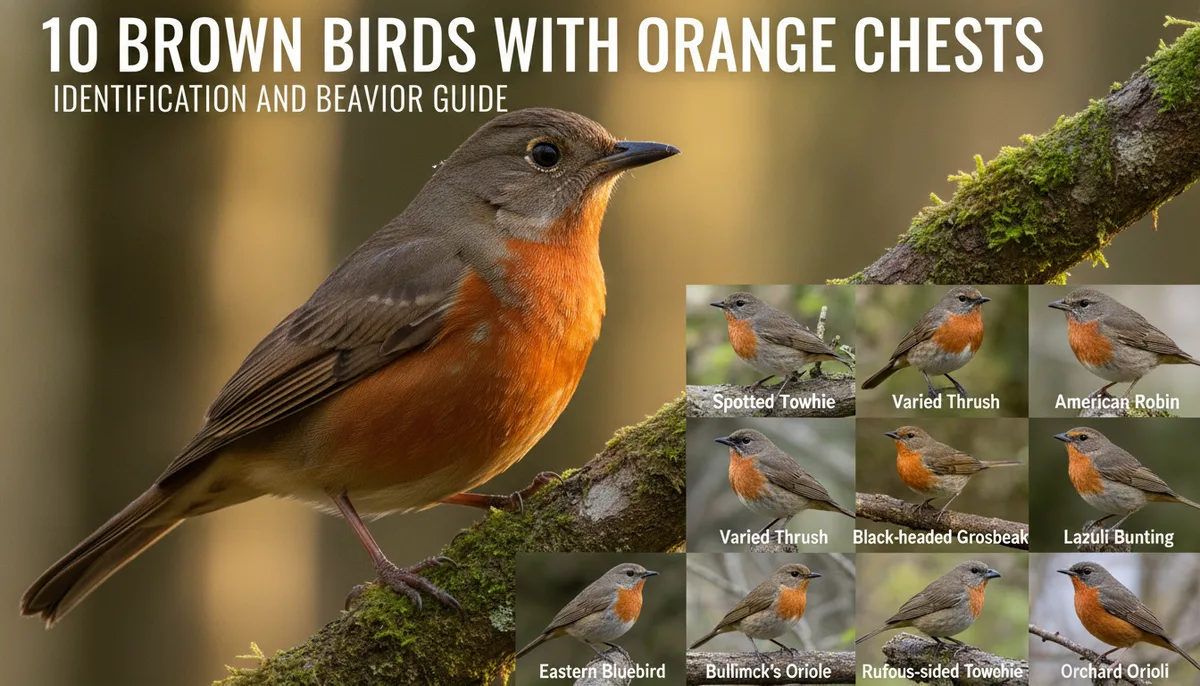
10 Brown Birds with Orange Chests: Identification and Behavior Guide
The sight of a warm, orange breast against a backdrop of earthy brown feathers is one of the most comforting sights in the avian world. Whether it is the classic silhouette of an American Robin on a spring lawn or the darting movement of a European Robin in a frost-covered garden, these birds carry a color palette that feels both vibrant and grounded.
Understanding why birds sport these specific colors—and how to tell similar species apart—is a foundational skill for any birdwatcher. In this guide, we will explore the biological "why" behind these colors and profile 10 species that showcase this beautiful combination.
The Science of Avian Coloration: Melanin vs. Carotenoids
Before we dive into our list, it is helpful to understand where these colors come from. A bird’s appearance isn't just for show; it is a complex biological result of evolution, diet, and physics.
Melanin: The Earth Tones
The brown, black, and gray tones you see on a bird’s back are primarily produced by melanin. This pigment is synthesized internally by the bird. Beyond providing camouflage, melanin makes feathers tougher and more resistant to wear and tear, which is why many migratory birds have dark or brown flight feathers.
Carotenoids: The Vibrant Oranges
The orange and red chests we are looking for today are usually the result of carotenoids. Unlike melanin, birds cannot produce carotenoids on their own. They must ingest them through their diet—specifically from fruits, seeds, and certain insects. If a bird does not get enough carotenoid-rich food during its molt, its orange chest may appear dull or even yellowish.
The Illusion of Blue
Interestingly, while we are focusing on brown and orange, you might see these birds alongside blue species. It is a common misconception that blue feathers contain blue pigment. In reality, there is no such thing as blue pigment in birds. Blue is a "structural color" caused by light scattering off the microscopic structure of the feathers. For a deeper dive into how light creates color, you might find our look at Black Birds with Blue Heads useful for understanding these optical tricks.
1. American Robin (Turdus migratorius)
The American Robin is perhaps the most iconic "brown bird with an orange chest" in North America. Despite its name, it is actually a member of the thrush family.
- Identification: Look for a dark gray-brown back and a rich, brick-red or orange breast. They have a white patch on the lower belly and white markings around the eyes.
- Size: Large songbird (7.9 – 11.0 inches).
- Behavior: Known for their "running and stopping" gait on lawns while hunting for earthworms.
- Interesting Fact: While often called the "harbinger of spring," many Robins stay in northern climates all winter; they simply move into the woods to eat berries, making them less visible to homeowners.
2. European Robin (Erithacus rubecula)
While it shares a name with the American version, the European Robin is much smaller and belongs to the Old World flycatcher family.
- Identification: A plump, round bird with olive-brown upper parts and a bright orange-red face and chest. The orange is bordered by a soft bluish-gray.
- Size: Small (5.5 inches).
- Distribution: Common throughout Europe, North Africa, and parts of the Middle East.
- Behavior: These birds are famously "friendly" in the UK, often following gardeners around to snatch up upturned worms.
3. Zebra (Orange-breasted) Waxbill (Amandava subflava)
Moving to the African continent, we find this tiny, vibrant finch.
- Identification: The male features a stunning orange breast that contrasts with olive-brown wings. A key identifier is the red "eyebrow" or stripe over the eye.
- Size: Very small (3.5 inches).
- Diet: Primarily seeds, though they hunt insects during the breeding season to provide protein for their chicks.
- Interesting Fact: They are highly social birds, often seen in small flocks, and engage in elaborate bowing rituals during courtship.
4. Sharp-shinned Hawk (Accipiter striatus)
Not all brown and orange birds are songbirds. The Sharp-shinned Hawk is a small, agile predator.
- Identification: Adults have a slaty-blue-gray back, but juveniles are distinctly brown. Both have a chest heavily barred with rufous (orange-brown) streaks.
- Size: 9.4 – 13.4 inches.
- Habitat: Dense forests and occasionally suburban backyards where they may hunt at bird feeders.
- Observation Tip: If you see a sudden silence at your feeders, a "Sharpie" might be nearby. To help protect your smaller visitors, consider using Window Feeders: Will Birds Actually Use Them? The Pros and Cons of Up-Close Magic which provide a closer view and can be placed near cover.
5. Varied Thrush (Ixoreus naevius)
Often mistaken for a "fancy" American Robin, the Varied Thrush is a bird of the Pacific Northwest's dark, damp forests.
- Identification: It has the classic orange breast and brown/gray back, but with a striking black (or dark brown) "necklace" or band across the chest and orange bars on the wings.
- Size: Similar to a Robin (9–10 inches).
- Voice: Their song is a unique, long, ethereal whistled note on a single pitch, followed by a note on a different pitch.
6. Eastern Bluebird - Female (Sialia sialis)
While the male is famous for his brilliant blue, the female Eastern Bluebird fits our criteria perfectly with her more subtle tones.
- Identification: The female has a grayish-brown back with subtle blue tints in the wings and tail. Her chest is a soft, warm orange-tan that fades into a white belly.
- Size: 6.3 – 8.3 inches.
- Diet: Insects and berries. They are a favorite among backyard birders who put out mealworms.
7. Black-headed Grosbeak (Pheucticus melanocephalus)
A common summer visitor to the western United States, this bird has a massive, "gross" (large) beak designed for crushing seeds.
- Identification: The male has a black head, but his body is a rich cinnamon-orange. The wings are black and brown with white patches. Females are more heavily brown-streaked but still retain an orange-buff wash on the breast.
- Size: 7.1 – 7.5 inches.
- Song: Their song is often described as a more melodious, "drunken" version of the American Robin's whistle.
8. Spotted Towhee (Pipilo maculatus)
The Spotted Towhee is a large sparrow that spends most of its time scratching through leaf litter.
- Identification: They have a dark brown or black head and back (heavily spotted with white) and bright rufous (orange) sides. The center of the breast is white.
- Behavior: Look for the "double-scratch"—a hop-step move where they kick back with both feet to uncover insects under leaves.
9. Barn Swallow (Hirundo rustica)
The Barn Swallow is a master of the air, recognizable by its deeply forked tail and acrobatic flight.
- Identification: While their backs are a shimmering steel-blue (which can look dark brown in low light), their underparts and chest are a beautiful cinnamon-orange.
- Size: 5.9 – 7.5 inches.
- Habitat: Often found near farms, bridges, and open fields where they catch insects on the wing.
10. Orchard Oriole - Female/Immature (Icterus spurius)
While the adult male Orchard Oriole is a deep chestnut color, the females and immature males are a greenish-brown with a warm, yellowish-orange chest.
- Identification: Slender birds with pointed bills. Look for the olive-brown tones on the back and the muted orange wash on the underside.
- Diet: Nectar, fruit, and insects.
- Garden Tip: You can attract orioles by planting nectar-rich flora. Check out our guide on Top 5 Red Flowers for a Hummingbird Garden: Low-Maintenance Plants for Busy Homeowners as many of these plants also attract orioles.
How to Identify These Birds in the Field
When you spot a brown bird with an orange chest, identification often comes down to the "GISS" (General Impression of Size and Shape).
- Check the Beak: Is it thin and pointed (insect eater like a Robin) or thick and triangular (seed eater like a Grosbeak)?
- Observe the Tail: Is it long and notched (Swallow) or short and square (Waxbill)?
- Look at the Orange: Does the orange cover the whole chest, or is it just on the sides (Towhee) or in a specific band (Varied Thrush)?
To get the best look at these details, a good pair of binoculars is essential.
Attracting Orange-Chested Birds to Your Yard
If you want to see more of these species, you need to provide the two things they crave: protein and carotenoids.
- Native Berries: Plant bushes like Winterberry, Serviceberry, or Chokecherry. These provide the natural pigments birds need to keep their orange feathers bright.
- Leaf Litter: Don't be too tidy! Leaving a layer of leaves under your trees provides a habitat for insects, which attracts Towhees and Robins.
- Water: A clean birdbath is often more effective at attracting "non-feeder" birds like Robins and Hawks than a seed tray.
For those looking to upgrade their entire backyard setup to accommodate a wider variety of species, our The Hummingbird Heart Master Buying Guide offers comprehensive advice on feeders and accessories that work for many of the birds mentioned today.
Conclusion
The combination of brown and orange in the bird world is a perfect marriage of utility and beauty. From the fierce Sharp-shinned Hawk to the melodic Varied Thrush, these birds remind us that even the most common colors have deep biological roots. By understanding their needs—from the carotenoids in their diet to the habitats they prefer—we can better appreciate and protect these vibrant neighbors.
Whether you are watching a Robin on your lawn or searching for a rare Waxbill, keep your field guide handy and your eyes peeled for that flash of orange.