
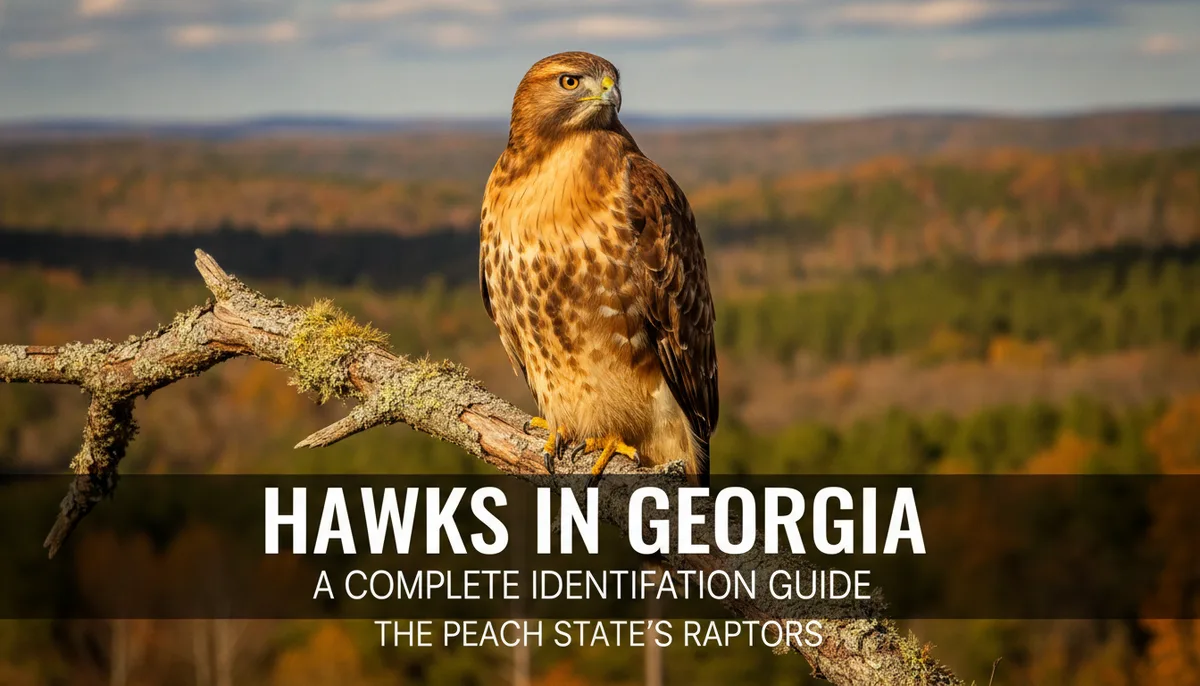
Hawks in Georgia: A Complete Identification Guide to the Peach State’s Raptors
Georgia is often celebrated as the "Peach State" for its agricultural prowess, but for birdwatchers, the state’s true bounty lies in its diverse geography. From the misty peaks of the Blue Ridge Mountains in the northeast to the sprawling, mysterious depths of the Okefenokee Swamp—the largest swamp in the United States—Georgia offers a sanctuary for a staggering array of wildlife.
With 438 bird species recorded, Georgia holds a respectable 32nd place in the national eBird rankings. Among these species, the birds of prey—specifically the hawks of the Accipitridae family—are some of the most captivating to observe. Whether you are scanning the Appalachian Plateau or watching your backyard bird feeder, understanding the nuances of these raptors adds a profound layer to the birding experience.
Understanding the "True Hawk" Taxonomy
Before diving into specific species, it is helpful to clarify the scientific jargon that often confuses even seasoned birders. When we talk about "hawks," we are usually referring to the family Accipitridae. However, the tree of life branches out significantly from there.
- Accipitrifomes: This is the broad order that includes most birds of prey.
- Accipitridae: A subfamily within that order, encompassing hawks, eagles, and kites.
- Accipitrinae: This is the "true hawk" subfamily. In Georgia, this includes the genus Accipiter (like the Cooper’s Hawk).
- Buteo: This genus includes birds like the Red-tailed Hawk. While technically not in the "true hawk" Accipitrinae subfamily, they are almost universally referred to as hawks and are a staple of the Georgian landscape.
To truly master hawk identification, you need a high-quality pair of optics that can handle the varying light conditions of Georgia's dense forests and bright coastlines.
The Red-shouldered Hawk: The Voice of the Southern Woods
The Red-shouldered Hawk (Buteo lineatus) is perhaps the most iconic raptor of the deep South. In Georgia, these birds are permanent residents, thriving in the damp, deciduous woodlands and river valleys that crisscross the state.
Identification and Size
The Red-shouldered Hawk is a medium-sized raptor, smaller than the ubiquitous Red-tailed Hawk but larger than the woodland Accipiters. Its most striking feature is the warm, rufous (reddish-brown) coloring that washes across its breast, head, and shoulders. When seen from below in flight, look for beautiful black-and-white checkered patterns on the wings and tail.
- Length: 16.9 – 24.0 inches
- Wingspan: 37.0 – 43.7 inches
- Weight: 17.1 – 27.3 ounces
Habitat and Behavior
In Georgia, you are most likely to find this hawk near water. They are the kings of the Okefenokee Swamp and the wooded estuaries along the 100-mile coastline. Unlike some hawks that prefer open fields, the Red-shouldered Hawk is a forest hunter. They sit on low perches, scanning the forest floor for snakes, lizards, frogs, and small mammals. Their call—a piercing, repeated kee-rah—is one of the most common sounds in the Georgian wilderness.
The Cooper’s Hawk: The Backyard Acrobat
If you have ever seen a hawk streak through your garden with terrifying speed, it was likely a Cooper’s Hawk (Accipiter cooperii). While many raptors prefer the wilderness, the Cooper’s Hawk has adapted remarkably well to suburban environments.
Identification and Size
The Cooper’s Hawk features a classic "stealth" look: dark blue-gray upperparts and a white breast with fine reddish-orange horizontal barring. Their long tails have dark bands and a distinctive rounded tip. A key identification feature is the "capped" look—their dark crown contrasts sharply with a lighter nape (back of the neck).
- Length: 14.6 – 17.7 inches
- Wingspan: 24.4 – 35.4 inches
- Weight: 7.8 – 24 ounces
Behavior in the Garden
Cooper’s Hawks are specialized bird hunters. They use their long tails as rudders to maneuver through dense branches at high speeds. Because they often frequent backyard feeders to hunt songbirds, they can sometimes cause distress for homeowners. Understanding Why Hummingbirds Fight: Managing Feeder Aggression can help you realize that nature is full of territorial and predatory behaviors, even among the smallest birds.
When a Cooper’s Hawk catches its prey, it uses its powerful talons to squeeze the life out of the animal rather than relying on its beak for the initial kill.
The Sharp-shinned Hawk: The Elusive Winter Visitor
Often mistaken for the Cooper’s Hawk, the Sharp-shinned Hawk (Accipiter striatus) is the smallest hawk found in Georgia. Unlike its larger cousin, the "Sharpie" is primarily a winter resident in the Peach State, migrating down from breeding grounds in Canada and the northern U.S. during the fall.
Identification and Size
To the untrained eye, the Sharp-shinned Hawk looks identical to the Cooper’s Hawk, featuring the same gray back and orange-barred breast. However, there are subtle clues:
- Size: They are significantly smaller, often no larger than a Blue Jay.
- Tail: The tail usually has a squared-off or notched tip, whereas the Cooper’s is rounded.
- Head: The head is smaller and appears more "integrated" into the body, lacking the prominent "cap" of the Cooper’s.
- Length: 9.4 – 13.4 inches
- Wingspan: 16.9 – 22.1 inches
- Weight: 3.1 – 7.7 ounces
Hunting Tactics
Sharp-shinned Hawks are the ultimate ambush predators. They prefer dense forests where they can hide in the thicket before launching a surprise attack on small songbirds. In Georgia, they are more common in the northern half of the state where the forests are denser, though they can be found statewide during the peak of winter.
The Red-tailed Hawk: Georgia’s Roadside Sentinel
No discussion of Georgia’s raptors is complete without the Red-tailed Hawk (Buteo jamaicensis). This is the quintessential "big hawk" that most people recognize. If you see a large bird of prey perched on a telephone pole along I-75 or soaring in lazy circles over a cow pasture, it is almost certainly a Red-tail.
Identification and Size
The namesake cinnamon-red tail is the best field mark, but it is only visible on adults (juveniles have brown, banded tails). From below, look for a "belly band"—a streak of dark feathers across the midsection—and dark "patagial" marks on the leading edge of the inner wing.
- Length: 17.7 – 25.6 inches
- Wingspan: 44.9 – 52.4 inches
- Weight: 24.3 – 51.5 ounces
A Master of Adaptation
Red-tailed Hawks are incredibly successful because they are not picky eaters. While they primarily hunt rodents like mice and voles, they are capable of taking down squirrels, rabbits, and even other birds. Their heavy build and broad wings are designed for soaring, allowing them to conserve energy while scanning vast areas of open ground.
Tips for Hawk Watching in Georgia
Identifying hawks can be challenging because of their height and speed. If you are looking to improve your skills, Georgia offers several premier locations:
- The Blue Ridge Mountains: During the fall migration, the ridges of North Georgia serve as a "highway" for thousands of hawks moving south.
- The Okefenokee Swamp: A prime location for Red-shouldered Hawks and even the occasional Snail Kite or Osprey.
- Barrier Islands: Locations like Jekyll Island or Cumberland Island offer clear views of the sky, making it easier to spot soaring Buteos and migrating Accipiters.
For those who prefer to watch birds from the comfort of home, setting up a specialized viewing area can be rewarding. If you enjoy seeing birds up close, you might consider how Window Feeders: Will Birds Actually Use Them? The Pros and Cons of Up-Close Magic can bring the action directly to your living room window.
Conclusion
Whether it is the piercing cry of the Red-shouldered Hawk in a cypress swamp or the silent, shadowy flight of a Cooper’s Hawk through a suburban oak tree, Georgia's hawks are a vital part of the state's ecosystem. By learning to recognize the differences in their silhouettes, plumage, and habitats, you can transform a simple walk in the park into a fascinating study of one of nature's most efficient predators.
To ensure you have the right gear for your next birding expedition, check out The Hummingbird Heart Master Buying Guide for recommendations on optics and field supplies that work for all types of bird watching.